Humm
A one-button voice notebook that sorts itself, shipped by one person on iPhone, iPad, Apple Watch and CarPlay.
- Role
- Founder; design and engineering
- Period
- 2025 to present
- Scale
- iPhone, iPad, Apple Watch, CarPlay
- Status
- Live on the App Store (March 2026)
What problem were we solving?
A lot of my ideas show up when my hands are busy: walking, driving, between meetings. By the time I can type, half of the thought is gone. I got the idea for Humm while power washing my fence and having a hundred ideas for things I couldn’t write down because my hands were busy.
Voice memos fix the capture and create a new problem: a pile of audio nobody listens to again. Notes apps fix the filing and make you do it yourself. Either way a thought costs you twice, once to save it and once to find it.
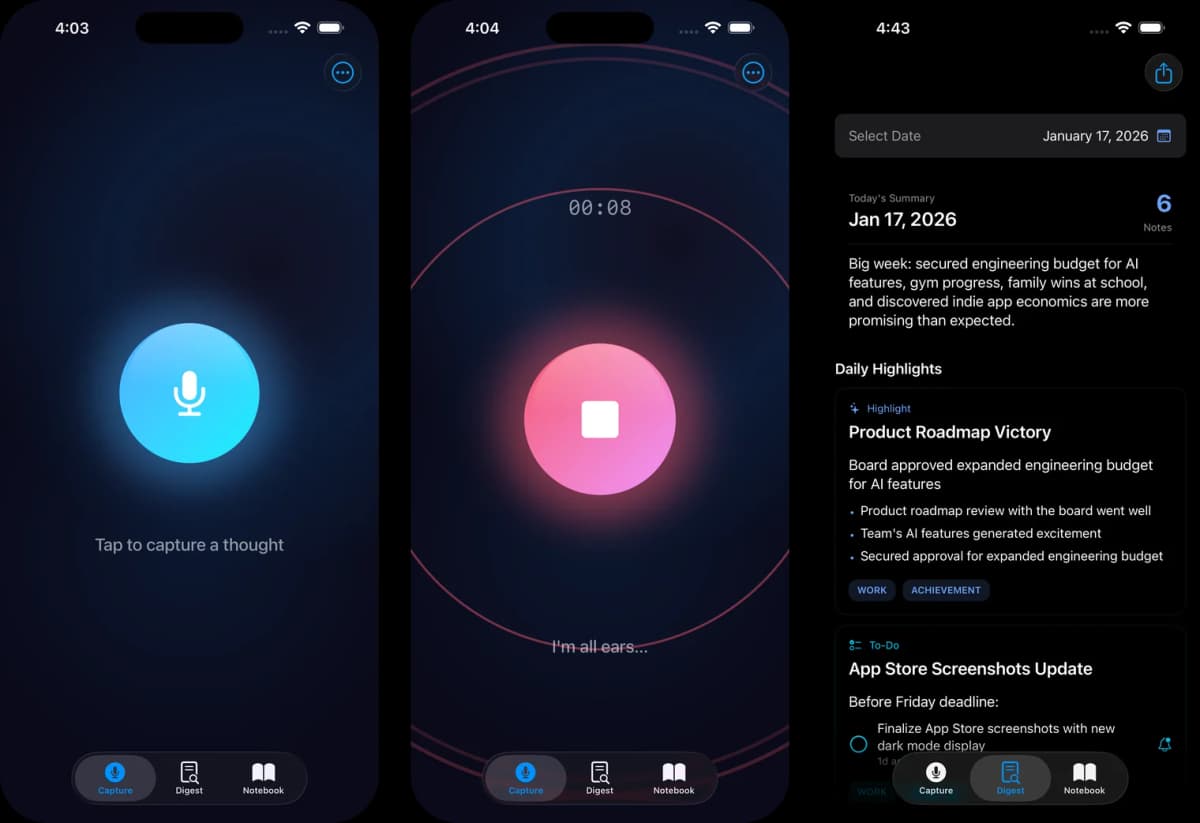
Humm’s bet is its tagline: “Speak it. Forget it. Find it later.” Capture should take one tap. Filing should take none. You talk, and Humm transcribes the note, sorts it into a task, question, idea, journal entry, note or scratchpad, and pulls out the people, dates and action items. Each morning it reads the previous day back to you as a digest.
What was my responsibility?
All of it. Humm is a Mind Meat Machine product and I’m the only person on it: product, design, the iPhone, iPad and Apple Watch apps, the backend, the App Store listing, pricing, the website and support. The website says it plainly: a team of two, one iOS engineer and his AI copilot, Claude.
The first commit, under the codename NeuroNote, is from September 27, 2025. A working daily digest ran within a week. The app became Humm in January 2026 and launched on March 26, 2026, six months after that first commit. Most of the work happened in the twelve weeks before launch.
What consequential decision did I make?
Nothing stands between the tap and the note
A capture app has one job. If the thought is gone by the time the app is ready, it failed. So the capture path waits on nothing it doesn’t have to. Humm transcribes on the device with WhisperKit, which means a note is captured and transcribed with no signal at all, and transcribing it costs nothing. Notes queue on the phone and sync when the connection comes back.
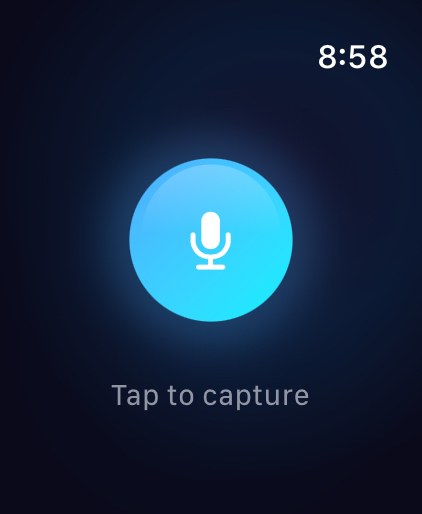
The same rule shaped the smaller choices. A Lock Screen widget, Siri and the Action Button all go straight to recording. Deleting a note happens at once, with four seconds to undo, instead of behind an “Are you sure?” dialog. And the Apple Watch app is the same single button. It records on the wrist and keeps the audio until the iPhone confirms it has the file, because a sync that deletes first and checks later loses notes.
Don’t give the model the last word
The digest reads your own words back to you, and some of what people say into a voice notebook is the hardest thing in their week. I didn’t want a language model deciding on its own how to answer that.
Before the model writes a digest, code checks the day’s notes for signs of crisis: self-harm, suicidal thoughts, domestic abuse. If it finds them, it tells the model not to write the reflective card. After the model responds, a second check in code catches anything that slipped through and replaces it with the 988 Suicide & Crisis Lifeline. Answers that touch health, law or money get a fixed disclaimer, appended by code and never generated.
Price the digest after people have seen one
The digest is what makes Humm more than a recorder. It’s also a cost that recurs every day for every user. In October 2025 I reworked how it’s generated: a smaller model, the fixed part of the prompt cached, and web search only when a note actually asks a question. My projection at the time was a cut of roughly 90% in the cost of each digest. Today a digest costs about a penny to generate, on average.
Pricing follows the same logic. Humm is free to download, and the free tier captures, transcribes and organizes unlimited notes. Humm Pro adds the daily digest, voice shortcuts and unlimited history, for $6.99 a month or $49.99 a year. The launch plan recommended $4.99 and $29.99. I kept the higher price. The offer to try Pro doesn’t appear at install. It appears a few seconds into someone’s first digest, once they’ve seen what they’d be paying for.
What happened?
Humm launched on the US App Store on March 26, 2026, for iPhone, iPad and Apple Watch. Version 1.0.1 followed three days later and added CarPlay, so a note can be captured from the car’s screen with one tap. I shipped CarPlay behind a server-side switch, so I could turn it off for every driver at once without waiting on an App Store review.
The next two updates fixed the same kind of bug. In 1.0.2 (April 18, 2026) and 1.0.3 (July 2, 2026), the problem was an app that looked signed in while saving a note quietly failed. For a capture app that is the worst failure there is: a thought you believe you kept and didn’t. The fixes were specific. Humm now checks the session every time it opens or comes back to the foreground. And when the server saved a note but the phone missed the confirmation, the retry now counts as a success instead of an error.
What did I learn or change?
I’m much more willing to pay for subscription management now. I’ve dealt with App Store and Google Play subscription problems since Warner Bros., and after Humm I use RevenueCat for every app. It’s worth the money to make sure customers get what they pay for.
Humm was the first big customer-facing product I built almost entirely with AI as my copilot, and at the time that was a lot harder to pull off than it is now. Building alone with AI changed what one person can take on. An iPhone, iPad and Watch app and the backend behind them went from first commit to the App Store in six months. The hard part moved from writing the code to deciding what to build and what to cut, which is the shift I wrote about in Will ‘Coders’ Exist in Five Years?
If I started Humm today, I’d watch how people want to use it before building much. We run a lot of user research studies at Meta, and I’d have loved to see that for Humm before I spent time on features people didn’t want.
Built with Claude as my pair programmer. Transcription by Argmax’s open-source WhisperKit.